WireGuard Multi-Hop Smart Networking
- Dev notes: WireGuard multi-hop smart networking development log, includes a funny demo you can try.
The networking feature is currently in beta (minimum supported version: v0.1.25). Please share feedback via QQ group, GitHub issues, or email.
Networking currently supports Linux hosts only.
frp-panel bundles wireguard-go to provide networking. It supports WireGuard over UDP/WebSocket multi-hop networking, custom routes and topology, and calculates the shortest path using latency and bandwidth so it works well even in complex network environments.
Getting Started
0. Concepts
Before you begin, make sure all of the following are true:
- At least one client in the network has a public IP to act as a relay node.
- All participating machines run Linux.
- At minimum,
frp-panel masterandfrp-panel clientare installed. frp-panel clientmust be installed with root privileges.
The networking sidebar contains four submenus:
- Network: Clients in the same network can communicate; a client can join multiple networks.
- Device: A client can bind multiple devices. Devices can join networks; devices in the same network can communicate.
- Endpoint: A device can bind multiple endpoints. Endpoints can be connected by other devices. An endpoint is usually a public IP + port.
- Connection: Two devices in the same network can establish a connection if at least one of them has a bound endpoint.
Example:
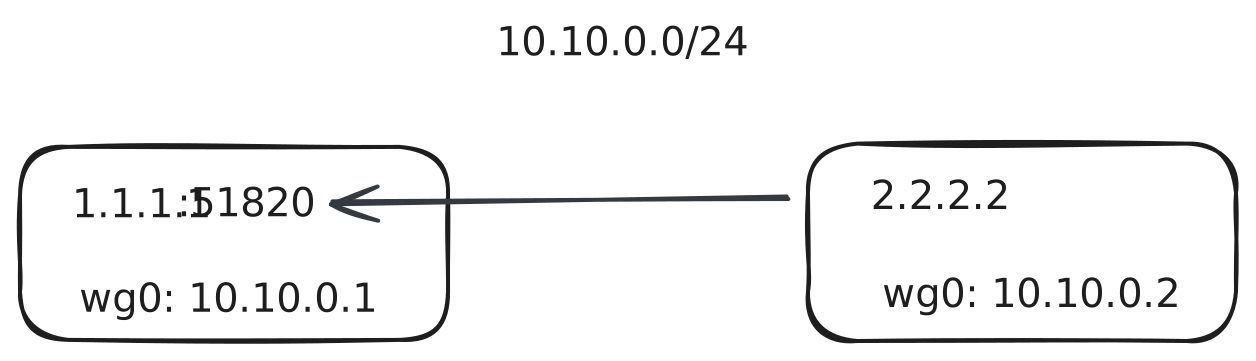
In the diagram, the two boxes represent two clients sharing the 10.10.0.0/24 network.
Left client:
- Has a device
wg0(virtual NIC) with virtual IP10.10.0.1. - Device
wg0binds an endpoint1.1.1.1:51820(public IP + port). - Device
wg0joins the network10.10.0.0/24. - Device
wg0can talk to other devices in the10.10.0.0/24network.
Right client:
- Has a device
wg0(virtual NIC) with virtual IP10.10.0.2. - Device
wg0joins the network10.10.0.0/24. - Device
wg0can talk to other devices in the10.10.0.0/24network. - The right client creates a connection to the left client via the endpoint
1.1.1.1:51820.
This lets the right client communicate with the left client through frp-panel networking.
1. Prepare the environment
The networking feature depends on kernel capabilities, so verify the environment first.
If your Linux system has /etc/sysctl.d, run:
echo 'net.ipv4.ip_forward = 1' | sudo tee -a /etc/sysctl.d/99-frp-panel.conf
echo 'net.ipv6.conf.all.forwarding = 1' | sudo tee -a /etc/sysctl.d/99-frp-panel.conf
echo 'net.ipv4.ping_group_range = 0 2147483647' | sudo tee -a /etc/sysctl.d/99-frp-panel.conf
sudo sysctl -p /etc/sysctl.d/99-frp-panel.conf
Otherwise, use /etc/sysctl.conf:
echo 'net.ipv4.ip_forward = 1' | sudo tee -a /etc/sysctl.conf
echo 'net.ipv6.conf.all.forwarding = 1' | sudo tee -a /etc/sysctl.conf
echo 'net.ipv4.ping_group_range = 0 2147483647' | sudo tee -a /etc/sysctl.conf
sudo sysctl -p /etc/sysctl.conf
Next, check whether the TUN device exists. If it does, skip; if not, resolve it first:
ls /dev/net/tunIf the command succeeds, continue.
2. Create a network
Open the networking sidebar, select Network, then click New Network. Fill in the form:
- Network Name: Use lowercase English; avoid special characters.
- CIDR: The network CIDR, e.g.,
10.10.0.0/24. This example covers10.10.0.0–10.10.0.255. - ACL: Optional. Controls permissions for direct connections. Example:
{
  "acls": [
    { "action": "allow", "src": ["cn"], "dst": ["cn"] },
    { "action": "allow", "src": ["us"], "dst": ["us"] }
  ]
}
action is allow or deny. src and dst are labels (any strings) used to group devices. Labels are assigned when creating devices.
In the example above, devices labeled cn can directly connect to cn, and us to us. Others cannot directly connect.
Manual connections are not governed by ACLs.
Click Submit to create the network.
3. Create an endpoint (skip for non-public nodes)
Go to Endpoint in the networking sidebar and click New Endpoint:
- Client: Choose a client with public internet access.
- Host Name: Public IP or domain, e.g.,
1.1.1.1orexample.com. - Port: Public-facing port, e.g.,
51820. - Type:
wsorudp.wsmeans WebSocket;udpmeans UDP. - URI: Leave empty for UDP. For WS, provide the full URI, e.g.,
ws://example.com:51820.
Click Create when done.
4. Create a device
Open Device in the networking sidebar and click Join Network to add a client to a network:
- Client: Select a Linux client installed as root.
- Network: Select a known network.
- Endpoint (optional for non-public nodes): Select an existing endpoint.
- Interface Name: Lowercase letters + digits only, such as
frpp0. The default value is recommended; invalid names cause startup failures. - Local Address: The device’s virtual IP, e.g.,
10.10.0.2. Must be within the network range. The default value auto-assigns an available IP. - Port: Device port, e.g.,
51820. For public nodes, match the endpoint port; selecting an endpoint will auto-fill it. - MTU: Device MTU, e.g.,
1420. The default is recommended. - Labels: Labels used for direct connection permissions. Use English and avoid special characters.
Click Submit to create the device.
5. Test the network
If everything goes well, your devices should now be networked. In Network, pick your network and open the Topology tab to view the routing graph.
In theory, if the shortest-path topology shows a route between two nodes (regardless of hops), those nodes can communicate.
Right-click a node in the topology and choose Open Terminal to test connectivity.
For example, on the 10.10.0.1 node, run ping 10.10.0.2. If it succeeds, networking works.
Click each edge to view detailed routing info.
6. Optimize the network (optional)
These settings help nodes pick better links. They do not affect basic functionality.
If things are stable, avoid manual optimization: manual links ignore ACLs, do not adapt to network changes, and incorrect settings can break connectivity. Proceed carefully if you must optimize.
By default, routing is based on latency only, which may be suboptimal.
You can drag from a node’s right black dot to another node’s left black dot to create a connection. When creating manual connections, avoid selecting endpoints to prevent issues when endpoints change.
You can provide actual bandwidth so it factors into shortest-path calculations.
If you need two nodes to always connect directly, you have two options:
- Configure ACLs so the two nodes can only communicate via direct connections.
- Create a manual connection between them and set bandwidth to 1000 Mbps so they prefer a direct link.